Ancient Opal Fossils Transformed into Contemporary Jewellery at the British Academy of Jewellery
17 Apr 2026
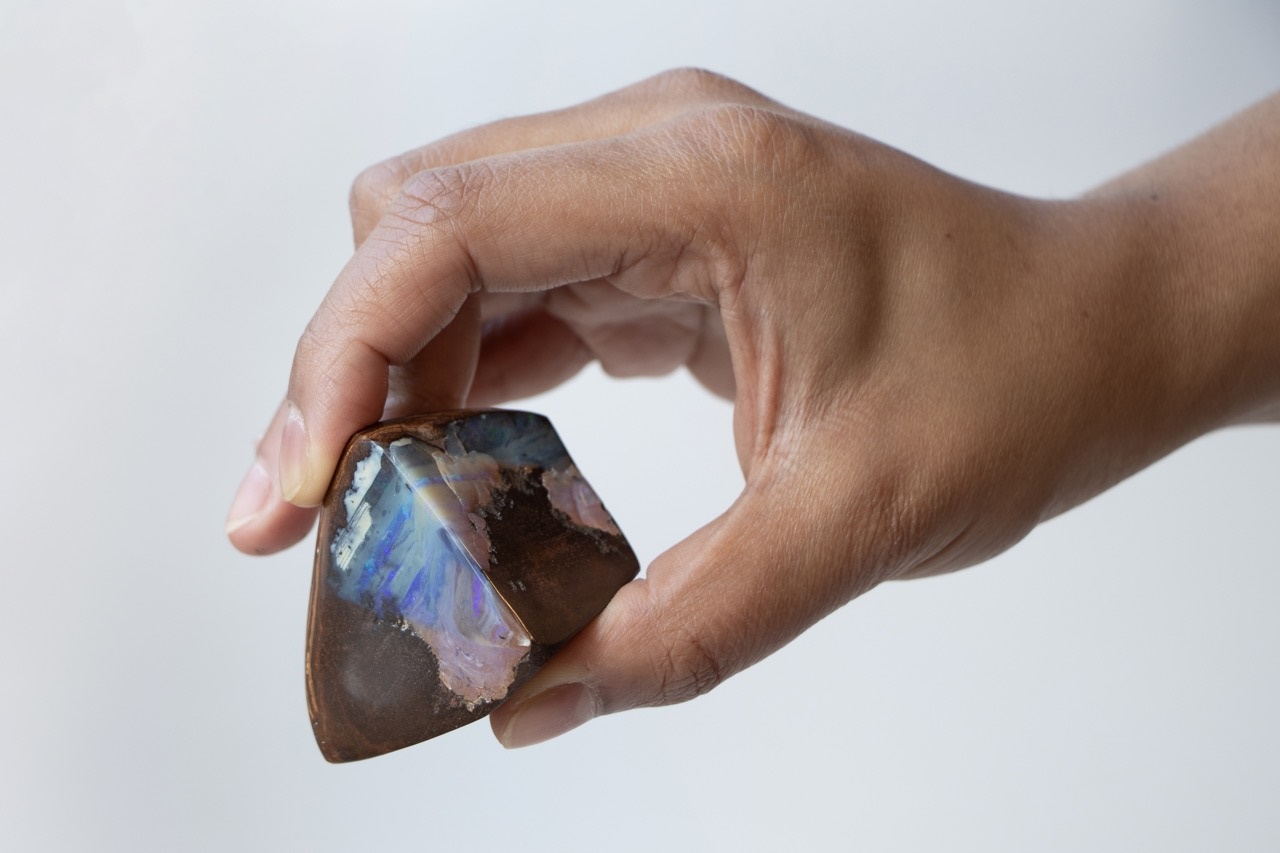
Ancient opalised fossils formed over millions of years in Australian mining regions are being transformed into contemporary jewellery at the British Academy of Jewellery (BAJ), through a partnership with UK-based opal specialist W.M Opals.
Sourced directly from Australian mining communities and cut in the UK by W.M Opals founder William McMellin, who has hands-on experience mining black opal in Lightning Ridge, New South Wales, each fossil has been prepared specifically for the project and assigned to BAJ students.
Designing with the material
Rather than working with standardised gemstones, students are challenged to respond directly to the irregular forms, subtle natural colour variation, and geological structure of each fossil.
Reem Grwan, BAJ Student, Level 4 Jewellery Design and Manufacturing, said,
“It’s challenging because every piece is completely different. You can’t plan everything; you have to adapt your design to the material as you go. I didn’t know anything about opals before. So many people don’t realise this. In jewellery, the industry is so focused on diamonds, but opals are far more individual and personal.”
From mining to making
The collaboration gives students insight into the full journey of the material, from mining through to finished jewellery, through direct engagement with industry practice and material sourcing.
William McMellin, Founder, W.M Opals, shared,
“A fossil is not a typical gemstone; the aim is to encourage students to design around the stone, drawing inspiration from its form and history.”
Industry engagement throughout
The project includes industry input at key stages, from briefing and design development to making-stage feedback and final exhibition, reflecting real working practice and direct engagement with an active industry specialist.
Bekkie Ora Cheeseman, Manufacture Lead. HE Lecturer said,
“Working directly with a practising miner and cutter gives students insight into sourcing, material decision-making, and professional standards. It encourages them to think about where materials come from and the importance of ethical sourcing. Responding to these opalised fossils, prepared specifically for the project, means students are designing with and for the stone — allowing its form, structure, and history to guide the making process. As a live project, it also gives them real-world experience of working directly with a client.”
Finished jewellery and exhibition
The resulting pieces, ranging from rings, brooches, and neckpieces to experimental wearable objects, will be presented in a dedicated exhibition. Selected works will also feature in BAJ’s end-of-year show, with three cut and polished Australian opals donated by WM Opals awarded as prizes.
Jewellery Design and Manufacturing at BAJ
BAJ’s Jewellery Design and Manufacturing course combines jewellery design development, technical training, and industry collaboration across Levels 3, 4, and 5, with Level 3 providing a strong foundation, Level 4 opening up contextual exploration through live projects and industry engagement, and Level 5 developing advanced practice and specialism.
More information on the Level 4 programme is available via the British Academy of Jewellery website.
View British Academy of Jewellery
Source: British Academy of Jewellery