Industry Outlook with David Brough: October
06 Nov 2024
By David Brough
Key takeaways from the 2024 CIBJO, World Jewellery Confederation, Congress
Planned EU silver classification to state possible reproductive health risks linked to silver
SHANGHAI, China - A new classification of silver under upcoming EU regulations which state a possible risk to the sexual and reproductive health of humans from handling the precious metal, risks causing “image damage” for silver in the public perception that will raise a requirement for effective communications by the industry, the CIBJO, World Jewellery Confederation, Precious Metals Commission reported during its session on the final day of the November 2-4, 2024 CIBJO Congress.
The new classification of metallic silver under EU regulations will take effect from May 1, 2026. No new restrictions will be required, but companies using silver in their processes are expected to incur additional costs for administrative matters, such as the obligation to draw up safety sheets. Labour protection must be adapted accordingly.
Classifications, labelling and packaging of individual products must be reviewed and adapted.
“Possible ‘image damage’ for silver in the public perception: counteract by informing customers, association work,” Karina Ratzlaff, a Precious Metal Commission Vice President, said in a presentation to the CIBJO Congress.
Separately, the ISO is considering a new proposal to update the definition of recycled gold that should be published in the first half of 2025, the CIBJO Congress heard.
A concern in the industry has been manufacturers sending back gold scraps from a given mine for recycling.
“Any gold traceable to a mine and segregated can keep the mined gold typology,” Jonathan Jodry, who specialises in ISO standards, said in a presentation to the CIBJO Congress.
The proposal will create sub-categories for recycled gold that are usable by the market but not mandatory.
“This standard will benefit everyone – it will make the standard cleaner,” Mr Jodry said in a presentation of the ISO Standards.
CIBJO Diamond Commission outlines developments to deliver correct diamond terminology and disclosure
CIBJO’s Diamond Commission reported on work currently being done to ensure that accurate information is being provided when disclosing whether a diamond is treated or laboratory-grown in order to protect consumers.
Speaking during the commission’s session at the 2024 CIBJO Congress, UK-based Raluca Anghel, Global Head of External Affairs and Industry Relations at the Natural Diamond Council (NDC), spoke of the importance of the correct use of diamond terminology and disclosure across the jewellery trade.
“We don’t have a lot of consumers who see the differences between natural diamonds and laboratory-grown diamonds,” she said. “Consumers need to understand these differences.”
The significant price differences that have opened up between natural diamonds and laboratory-grown diamonds reinforce the need for correct disclosure to protect consumers, Ms Anghel said.
The CIBJO Diamond Blue Book is a vital tool in determining the correct use of the terms for synthetic diamonds, laboratory-grown diamonds and laboratory-created diamonds, she added.
“The Natural Diamond Council focuses a lot on driving marketing efforts and supporting brands and designers in bringing content to consumers. But where we see consumers affected by incorrect disclosure, we act,” Ms Anghel said.
The NDC has sought to protect consumers by reporting to the relevant authorities any inappropriate use of diamond terminology in retail around the world.
UK consumer habits shift as hallmarking numbers fall, CIBJO is told
UK jewellery consumer habits are shifting, with numbers of hallmarked items sharply down and town centres transforming, but jewellery stock values are rising due to the impact of buoyant gold prices, UK retailer John Henn, who heads a committee that largely covers the retail jewellery sector, told the CIBJO Congress.
In the last 20 years, 27 million fewer items of jewellery are being hallmarked in the UK, Mr. Henn reported.
Mr. Henn referred to a reduction in the sale of hallmarked articles caused by some private transactions within certain segments of the retail market and a rise in retail internet sales, with some jewellery buyers apparently not aware if goods were correctly hallmarked.
He also referred to a fall in occupied office space in major cities, including London, a large number of closures of brick-and-mortar retail stores across the board, and a sharp drop in marriages in the United Kingdom in recent years, which had eroded engagement and wedding ring sales.
The buoyant gold price has boosted the value of stock held by jewellery retail stores in the country, Mr. Henn said.
This trend was largely due to the recent surge in gold prices to a series of all-time highs.
Mr. Henn, who owns an independent jewellery business based in Wolverhampton in central England, also spoke of a transformation of the high street in the UK due to the changing face of retail linked to increased digital retail sales.
Special panel at CIBJO Congress assesses impact of geopolitics and government policies on jewellery industry
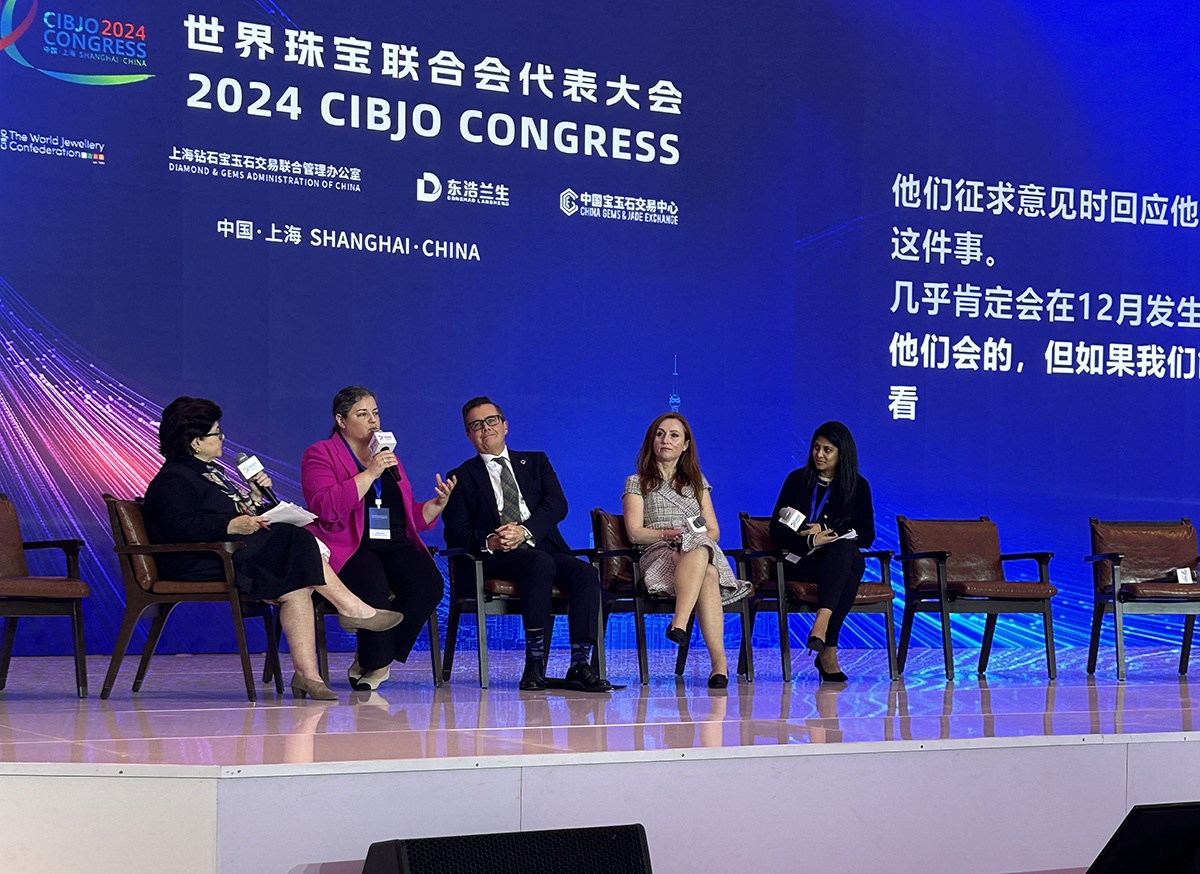
A special panel on the opening day of the CIBJO Congress in Shanghai, moderated by UK-based Jewellery Outlook Editor Mr David Brough, looked at how geopolitics and government policies impact the jewellery industry and considered how the industry can participate in the formulation of such policies and respond to growing government oversight.
The panellists addressed how events of geopolitical significance, such as the wars in Ukraine and the Middle East, as well as factors like falling U.S. interest rates and central bank buying, had buoyed gold prices and how jewellers had responded, for example, by manufacturing more lightweight designs through technologies such as electroforming.
Source: David Brough