Issues regarding protection and transmission of COVID-19
12 Jun 2020
Issues to be considered regarding the protection of the workforce and the general public through the disinfection and sterilisation of jewellery and other products used within the jewellery and giftware industry environment during the COVID-19 pandemic.
Author: Dr Richard Taylor | Opinion
The first thing to consider is the limits of our current knowledge:
As the jewellery industry plans the resumption of business the question of protection for both work colleagues and the general public becomes an important issue for the industry. This article attempts to highlight and discuss the issue of infection risks to colleagues and the general public from handling jewellery products and the control of the risk of cross-contamination.
Many research projects around the world are underway and as they report and publish findings knowledge and understanding of the virus will improve modifying our current understanding. This means that what we understand to be ‘best practice’ now will most likely evolve and be modified over time. It will be important for all members of the industry to be proactive in keeping up to date with developments and best practice as we go forward.
Just over 6 months ago the virus known as COVID-19 was unknown, Coronaviruses of which COVID-19 is a new strain, was first characterised in the 1960s. So much research has been completed into coronavirus over the last 40 years, but unfortunately much of this knowledge does not apply to this new strain. The limited length of time since COVID-19 was discovered means the amount of research completed into this particular strain is incomplete leaving questions and gaps in our understanding of the virus and its transmission.
It must also be emphasised this article is not meant to be exhaustive; it has been created to be informative but cannot address the hazards and risks associated with any individual business. It should be used only to assist in the process every business is required to complete. Some of the examples given could be used as a template but it should not be used as an alternative to a business completing their own risk assessments.
A route map for assessment:
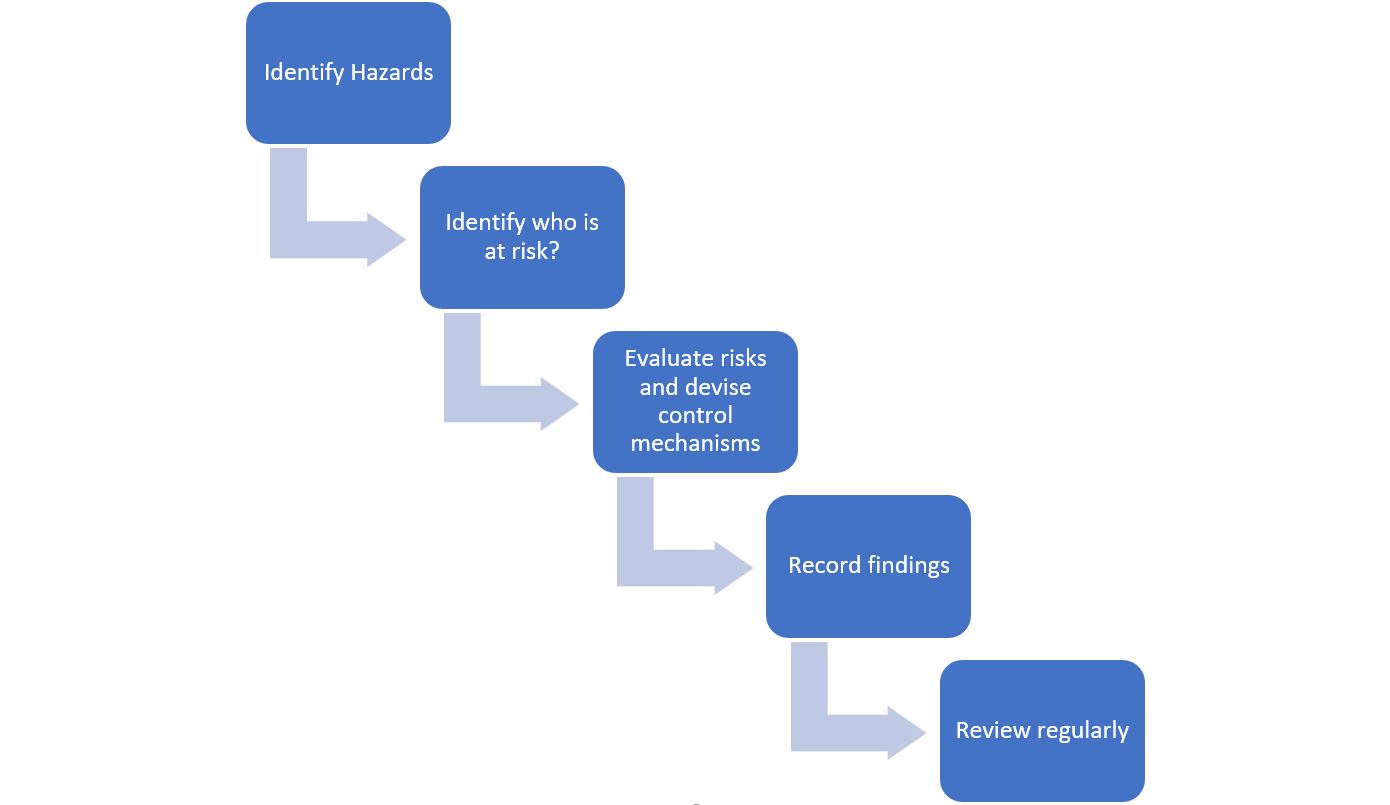
For example:
| Existing stock hazards: |
Contracting COVID-19 through contact with contaminated stock |
| Who is at risk: |
Visitors to workplace, clients, staff and colleagues |
| Evaluate risks and mitigation/ controls: |
? |
| Record findings: |
? |
| Review regularly: |
? |
Risks could be identified as:
|
Risk
|
Who
|
Severity
|
Removal
|
Mitigation
|
| Handling existing contaminated stock |
Visitor
|
Insignificant, stock has been untouched since beginning of lockdown
|
N/a
|
N/a
|
|
Staff
|
Insignificant, stock has been untouched since beginning of lockdown
|
N/a
|
N/a
|
|
Customer/ general public
|
Insignificant, stock has been untouched since beginning of lockdown
|
N/a
|
N/a
|
| Handling contaminated new stock deliveries |
Visitor
|
Insignificant, visitors have limited exposure to stock
|
N/a
|
N/a
|
|
Staff
|
Significant
|
N/a
|
Wear protective gloves
Disinfect stock following handing
Limit handling of stock
|
|
Customer/ general public
|
Significant
|
N/a
|
Disinfect stock following handing
Limit handling of stock
Disinfect purchases
|
|
Inward postal clerk
|
Significant
|
|
Wear protective gloves
Disinfect stock on delivery disinfect stock following handing
|
| Handling of stock previously infected by work colleague |
Visitor
|
Insignificant
|
N/a
|
N/a
|
|
Staff
|
Significant
|
N/a
|
Wear protective gloves
Disinfect stock following handing
Limit handling of stock
|
|
Customer/ general public
|
Significant
|
N/a
|
Disinfect stock following handing
Limit handling of stock
Disinfect purchases
|
| Handling of contaminated stock contaminated by a member of the general public |
Visitor
|
Insignificant
|
N/a
|
N/a
|
|
Staff
|
Significant
|
N/a
|
Wear protective gloves
Disinfect stock following handing
Limit handling of stock
|
|
Customer/ general public
|
Significant
|
N/a
|
Disinfect stock following handing
Limit handling of stock
Disinfect purchases
|
What are the common methods of sterilisation and disinfection?
- Chemical
- Heat
- Radiation
- Quarantine
- Steam
Chemicals
What chemicals kills the covid 19 Virus?
There are a number of recognised national databases around the world that have details of chemicals that will kill viruses including corona virus and some have detailed the results of tests for effectiveness on covid 19.
Some of the most effective chemicals listed are poisons that potentially can cause harm or have the potential to kill anyone having contact, so the chemicals that are of most interest in this situation are chemicals that are harmless or with mild contra indications to health. It would be prudent to limiting any selection to ones with appropriate approval for use. In the UK we have aligned with the European Approvals legislation.
All chemicals are tested to determine the required concentration to ensure complete sterilisation, another issue that is addressed is the length of exposure that is required for complete sterilisation. Finally, a further issue tested is the potential of the virus to gain increased resilience from dilution with other biological material. These issues should be considered when considering chemical sterilisation.
As general advice:
Always read and follow the directions on the label to ensure safe and effective use.
- Wear skin protection and consider eye protection for potential splash hazards
- Ensure adequate ventilation
- Use no more than the amount recommended on the label
- Use water at room temperature for dilution (unless stated otherwise on the label)
- Avoid mixing chemical products
- Label diluted cleaning solutions
- Store and use chemicals out of the reach of children and pets
Possible chemicals include:
|
Chemical
|
Concentration
|
Exposure time
|
|
|
Soap
|
Foam
|
Minimum 20 seconds
|
Readily available
|
|
Household bleach (sodium hypochlorite)
|
Typical concentration 5 tablespoons bleach per gallon water at room temperature bleach only remains active for 24 hours
|
Minimum 1 minute
|
Readily available
|
|
Alcohol (ethanol)
|
Over 70% concentration
|
30 seconds
|
Limited resources due to pandemic fire risk flammable
|
|
Isopropyl alcohol
|
Over 70% concentration
|
30 seconds
|
Limited resources due to pandemic fire risk flammable
|
|
Quaternary Ammonia
|
Follow directions
|
30 seconds
|
Applications with ongoing testing. Safety concerns over use including lung irritant and asthma
|
|
Hypochlorous acid
|
Not tested or approved in Uk or Europe for covid 19 use.
Tested in USA on another corona virus >99.9% effective
USA approved in certain food prep environments
|
60 seconds
|
Due to lack of approval any use in UK questionable Products are however available in the market in the UK
|
Quaternary ammonium includes any of the following compounds:
- Benzalkonium chloride
- Benzethonium chloride
- Alkyl dimethyl benzyl ammonium chlorides (C12-16)
- Alkyl dimethyl benzyl ammonium chloride (C14 60%, C16 30%, C12 5%, C18 5%)
- Alkyl dimethyl ethylbenzyl ammonium chloride (C12-14)
- Alkyl dimethyl ethylbenzyl ammonium chlorides (C12-18)
- Didecyldimethylammonium chloride
- Dioctyldimethylammonium chloride
Chemicals could be combined within ultrasonic cleaning systems but as far as sterilisation is concerned the chemical present alone would be the method of sterilisation. Most ultrasonic tanks are heated that may be inappropriate with certain chemicals, certain chemicals could create noxious vapours, certain chemicals could evaporate diminishing their sterilisation properties.
Heat
Heat can be used in a number of ways to sterilise and disinfect items including:
Dry Heat
With dry heat the bacteria are burned to death or oxidized. Dry, hot air is much less effective in transferring heat than moist heat. This is why microorganisms are much more able to withstand heat in a dry state. The dry heat sterilization process takes a long long time and is done at a high temperature (2 hours at 160°C). The total cycle time, including heating up and cooling down to 80°C can take about 10-11 hours, not the greatest solution for an active clinic that needs its instruments to be readily available. With forced cooling, the time may be reduced to five hours. Requires capital purchase and safety issues regarding use serious risk of burns
Moist heat sterilisation
Of all the methods available for sterilization (killing or removal of all microorganisms, including bacterial spores), moist heat in the form of saturated steam under pressure is the most widely used and the most dependable method. Steam sterilization is nontoxic, inexpensive, rapidly microbicidal, and sporicidal. It rapidly heats and penetrates fabrics. Moist heat sterilization using autoclave is commonly used for the sterilization of biohazardous trash, heat and moisture resistant materials such as aqueous preparation (culture media). This method is also used for the sterilization of surgical dressings and medical devices. Requires capital purchase and safety issues regarding use serious risk of burns.
Boiling
Use boiling to sterilize metal, rubber or plastic boil for 20 minutes. Start counting the 20 minutes when the water starts boiling.
Radiation
There are a number of ionizing radiations that can be used to sterilise and disinfect but the only realistic viable possibility for the jewellery industry is UV radiation. High energy UV radiation can be very efficient at sterilisation although its speed and efficiency are controlled by 4 factors.
This means for effective sterilisation including viruses as well as bacteria the exposure required needs to reach a certain minimum. The minimum is calculated as the 'sum of the four factors detailed below.
The first of the four factors are the type of UV light used the wavelength/type of UV used is very important as some types have very limited/ weak effects. UV light can be described as UVA (315-400nm), UVB (280-315nm) and UVC (200- 280 nm)' there is also vacuum UV (VUV) (100 - 200 nm) but it's strongly absorbed by air so difficult to use in normal environments. UVA and UVB are not effective at sterilisation UVC and VUV are recognised for their sterilization properties.
The distance of the item being sterilised from the UV light source is governed by the 'inverse square rule' this means 'the radiation exposure from a point source (with no shielding) gets smaller very quickly the farther away it is'. So, the distance between the item being sterilized and the light source is a very important factor.
The length of exposure time is the third factor so increasing exposure time can partially offset limitations from the other two factors described.
The final factor is the intensity of the radiation emitter, that will control the intensity of incident light in combination with the distance although the intensity being a linear relationship would have less significance than distance between source and object being irradiated unless at very close proximities.
It must also be remembered that it is 'light' that is doing the sterilisation so for '3D' objects all surfaces must be directly exposed to the light to be effective this may require many different treatments at different orientations to be utilized for each item to ensure complete coverage of the entire '3D' surface.
Other considerations are the health and safety of your staff in working with high energy UVC. Exposure can cause burns, and increase the risk of skin cancer, and damage the eyes.
I think careful research into both the safety of the system and its operation and also the efficiency of the system would be essential to ensure safety for all retailers intending to purchase or use a system.
Further, UVC and VUV are both ionizing radiations which means they can change the properties and /appearance of items exposed: colours can change textures and properties can be modified. Certain gemstones could be affected, leathers, plastics and fabric materials could also be affected. Metals should not be affected, watch glasses? possibly in some cases dependant on the material they are composed of also glues and adhesives that could have been used in manufacture could be affected.
The compromise in the design of any system will be in general the shorter the wavelength of UV used the more effective and quicker the sterilisation process, but the shorter the wavelength of UV the more inherently dangerous and potentially damaging the radiation is.
Finally, UV light sources are generally not single-wavelength sources they can emit over a range of wavelengths creating an additional complexity to any evaluation.
Quarantine
Many organisations have used quarantine as the mechanism to mitigate contamination risks, obviously, handling of items going into quarantine must be risk assessed and controlled as well as the length of time as research is limited although 72 hours is a frequently used period.
Steam cleaners
Many workshops and retailers have steam cleaners the three issues that should be considered are
- The length of time the item requires to be held in the steam jet to ensure sterilisation, no research exists, so the risk assessment must include this issue and decide on a exposure time that will robust under scrutiny.
- The possibility certain items will be damaged by the process
- The implication that the process creates by nature creates an aerosol that may carry the virus some of which may not have been killed. This risk would have to be assessed in relation to risks for both the operator and anyone in the vicinity of the equipment.
It may be considered the risks are too great and such that can’t be mitigated with PPE.
One of the more obvious conclusions from the above is that for businesses with a variety of product there will need to be a range of strategies and procedures to suit individual product types it is unlikely there will be a one fits all strategy. In some cases there will be competing demands of the requirement to sterilise the stock and the demand of protecting the stock from
any adverse effects of sterilisation so both aspects must be considered as part of the risk assessment, secondly, the protection of staff will also be a very important aspect with procedures potentially involving clearly defined stages to create this protection.
This could for an example include in the retail environment anyone serving a client wearing protective gloves to handle the stock. On completion of the sale still wearing gloves place items handled by the client into the selected sterilisation methodology, then remove gloves, hand wash and fit new gloves to then remove items from sterilisation and place items back on display.
It may also mean that items manufactured from multiple component materials may require more than one methodology to be applied to each methodology suitable for the individual components. It should also be born in mind repeated sterilisation may have a cumulative detrimental effect on the item.
Stay informed
Get the most important updates and insights in the jewellery industry by subscribing to the NAJ Newsletter. It's free.
Join the NAJ Mailing List
Source: Dr Richard Taylor