The Jeweller Spring 2022: Sierra Consultancy – CAD Knowhow Meets Design Empathy
01 Mar 2022
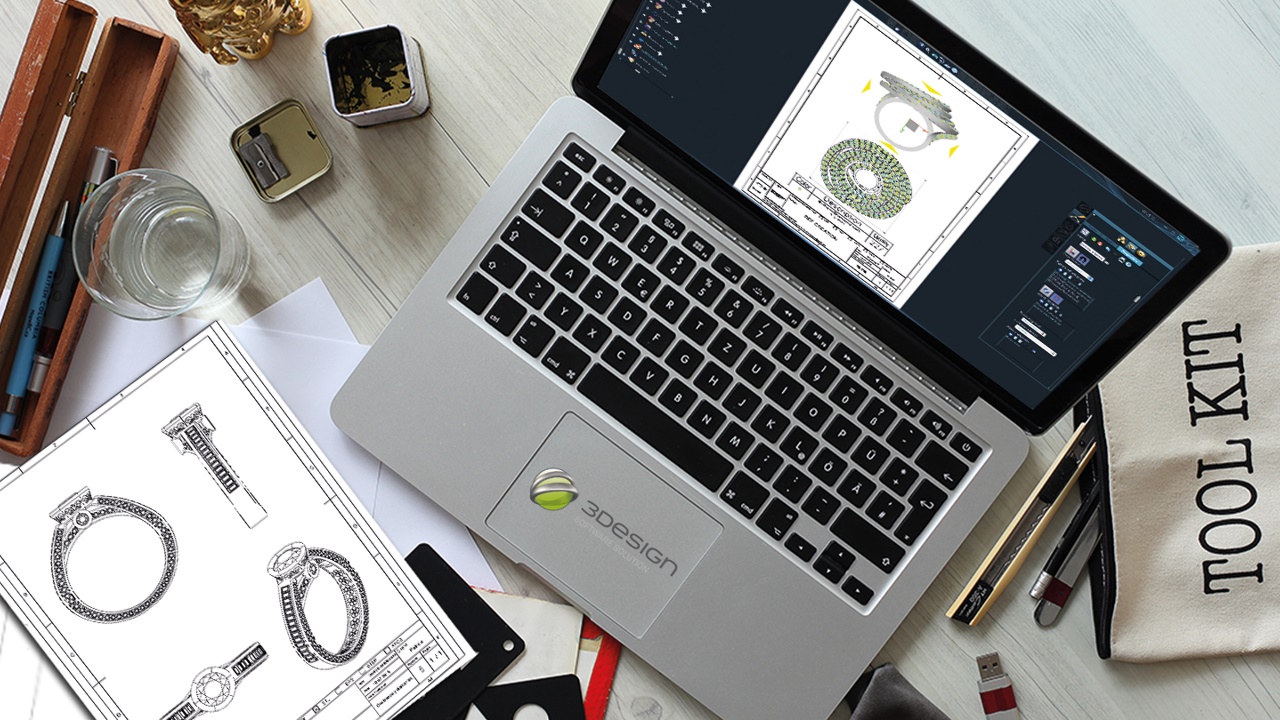
With a background in benchwork and design, Pooja Sahny of jewellery CAD CAM specialist Sierra Consultancy understands the challenges faced by her designer clients.
When did you first embark on a career in the jewellery world and what led to that?Having studied and worked in the heart of the Antwerp Diamond District in Belgium, I know there is no better industry than the jewellery industry. With my family also in the trade, it seemed only natural for me to follow this path. I originally trained as a silversmith, then, having gained a passion for metal forming, I pursued goldsmithing.
View Sierra Consultancy

Image: Pooja Sahny of jewellery CAD CAM specialist Sierra Consultancy
Tell us your journey – where did you train, then work, after graduating?
My education was in Antwerp, Belgium. After graduating I was fortunate to gain work experience with a local goldsmith who taught me the practical way to make things at the bench... versus what I was taught in college. It was insightful to see what technical skills I needed to create my own collections. Everything was handmade at this point.
I participated in numerous museum exhibitions, such as the Diamond Museum in Antwerp (now called DIVA) and competitions. Being a finalist for the Henry van de Velde Prijzen in 2004 for best product and the HRD (now AWDC) Awards ‘Diamonds are Fun’ in 2005 gave me the confidence to continue designing.
In 2007, with technology becoming a big influential factor, I enrolled in the GIA campus in London for its Computer Aided Design course. Following certification I spent four years as a part-time designer in a Belgian family-owned diamond jewellery manufacturing company. We used numerous CAD software packages: ArtCAM JewelSmith, Rhino and 3DESIGN. My time there gave me a deeper understanding of the various stages of manufacturing and encouraged me to pursue CAD even further.
It was after this that I joined Gravotech (formerly known as Type3, the developer of 3DESIGN) as a sales and support manager for its software... and I gave up my benchwork.
When did you establish Sierra Consultancy and why?
In 2019, after seven years with Gravotech, I set up Sierra Consultancy – an inevitablity. I wanted to be able to give back to an industry that has played a big part of my life, and at the same time broaden my horizons by offering my experience and take on project work and since that time I’ve been a part of some great opportunities and formed strong partnerships.
In 2019 I helped to write the 3D Design CAD brief for the Goldsmiths’ Craft & Design Council (GC&DC) awards and assisted as a judge. It was insightful to be on the other side, especially with my experience as a designer entering competitions and a finalist twice in Belgium. This event inspired me and brought me back to my roots. It was a great honour to be a GC&DC award judge in 2020 and then again in 2021.
In 2020 I started working alongside HS Walsh & Sons to help distribute 3DESIGN CAD software. They are a great team and 2021 was a busy year. Hockley Mint joined our 3Design Partner list by becoming a service bureau, and this year the Jewellery Academy of Wales (JAWS) have been added to our list as a new educational institute.
We also had the chance to work alongside Cooksonsgold on an exciting design project. Watch this space for more details about the project!
How has the jewellery industry changed for you (and others) since you’ve been in it?
The jewellery trade 20 years ago is very different to what it is now. I grew up in a conservative environment where an Indian woman to hand make jewellery and build a career was quite unheard of. I fought hard to overcome challenges and setbacks and was often treated a certain way because of this. These preconceptions have made me who I am today. I understand the challenges of other designers that are in similar shoes, be it regarding ethnicity, gender discrimination or disability.
My goal is to encourage, support and promote jewellers; make them aware of the range of opportunities that are available to help them become the best version of themselves.
I feel more integrated in the UK industry than I did in Antwerp. Antwerp was lacking was a jewellery support network, and I have been very grateful to find this with the NAJ and my partners.
What was the appeal of working with 3DESIGN – over and above other CAD providers?
3DESIGN is perhaps lesser-known than other CAD software, mainly due to the fact that there are no illegal or cracked versions available on the market. All licences are official and come with official support and training.
3DESIGN has a strong network of clients and distributors worldwide that support each other. As distributors we take a similar approach with our clients – we provide them with training and support that suits their style and, most importantly, budget.
I’m fortunate to have a great network of clients. Over lockdown we had many chats and we still talk regularly – they know they can reach out at any time.
My advice to anyone looking to become a CAD jewellery designer is to choose a professional software you feel comfortable with, give yourself time to make mistakes and practice, practice, practice. These are the reasons why I chose to work with 3DESIGN. I believed in it, I understood it and have seen it mature over the years.
Does your career background help when it comes to explaining and selling the benefits of CAD CAM?
Yes. I can now look back and see how far I’ve come. Like many bench jewellers, I was not the most tech savvy. I could write emails, use Facebook and Google, but to put my creations onto a computer... the software intimidated me. I remember thinking this makes absolutely no sense! Why would you call a tool Curve Sweeping and how do you understand your 3D views using planes and axis? Once I found my own logic, I applied this and it stuck.
I understand the initial frustration and overwhelming sensation of entering the world of CAD CAM. The one thing to remember is that your computer will not explode and that you have the ability to undo something!
The reality is that many clients now want or expect a render (photo-like image) when they place a bespoke order with their local jeweller. It’s about taking that knowledge you have at the bench or importing sketches and turning them into a 3D finished looking model.
Would you say that there are still some/a few/many jewellery businesses out there who are reluctant to employ CAD?
Definitely. There is still this misconception that bench jewellers will be out of a job. This is far from the truth! We encourage our clients to use both methods of creation... CAD and benchwork. CAD speeds up certain processes such as resizing, eliminates the loss of precious metal particles or scraps and allows users the freedom to work from anywhere. The bench jeweller, on the other hand, has the knowledge of how to make a design practical and put it all together.
What are the other issues? Do these vary according to their particular sector of the jewellery industry?
Another concern is money. Professional CAD software can be expensive, which is why we have an entry level called 3DESIGN Atelier. Like everything, CAD is an investment to help grow your business and offer a more one-to-one design service. You pay for what you get. There are free software solutions out there, however, what may take 30 minutes to create in their software could be accomplished within a matter of minutes in 3DESIGN.
Tell us about the courses that Sierra Consultancy offers.
We have one-to-one courses and group courses to learn 3DESIGN. There are three levels of courses available: Beginners, Intermediate and Advanced. One-to-one courses are provided by both ourselves and our partner, Jack Meyer from CAD Jewellery Skills.
The British Academy of Jewellery runs our group courses, and we are happy to announce that this spring, our new partner, Jewellery Academy of Wales, will be conducting online evening courses. This is ideal for those who work fulltime.
View Sierra Consultancy
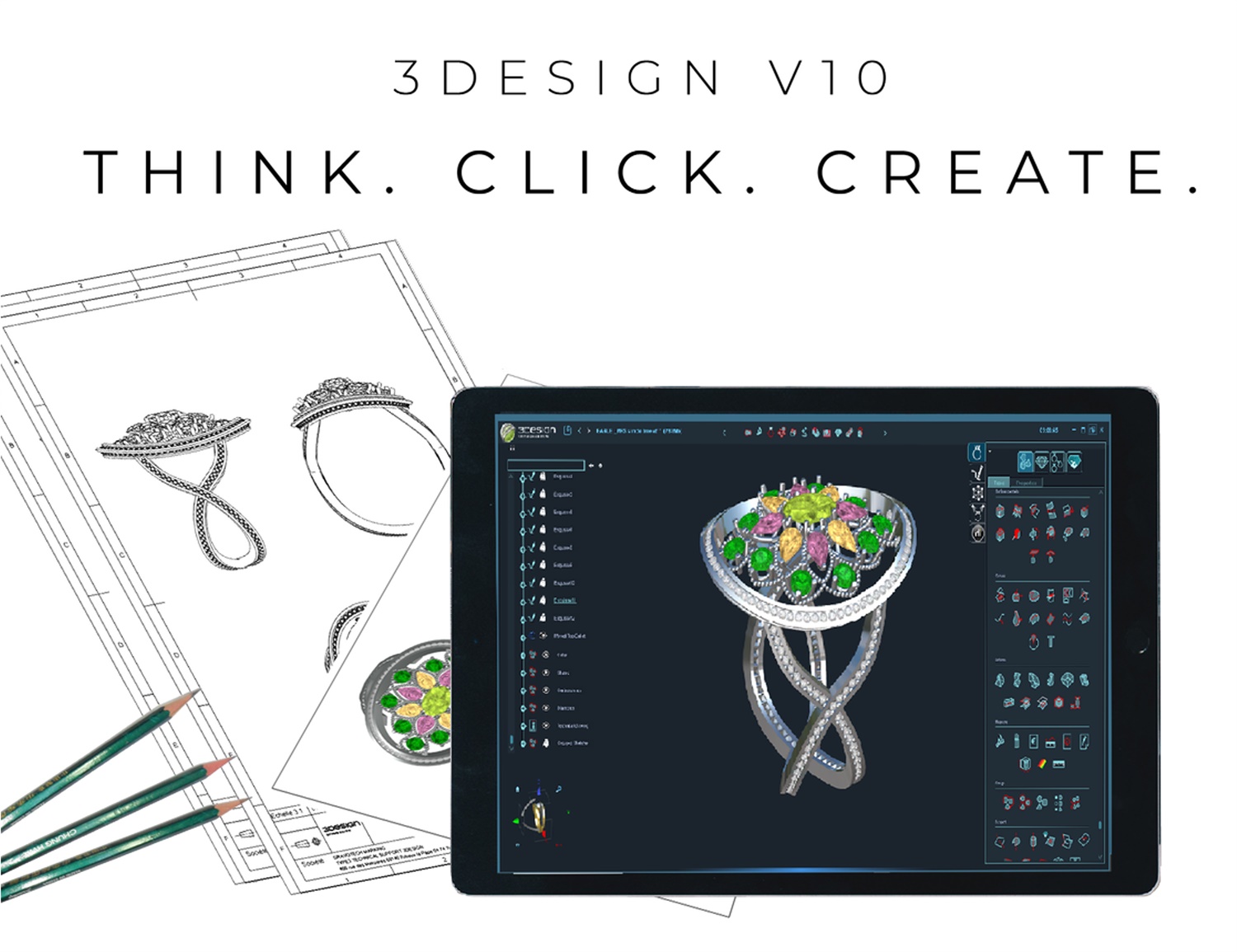
The 3DESIGN packages
As the official 3DESIGN reseller, we offer three versions of the software: Professional, Designer and Atelier.
3DESIGN Professional is the premium version of the software with all 3DESIGN tools and builders inside. It allows you to create your own STL files required for 3D printing (STL stands for Standard Tessellation Language, or STereoLithography.) It also includes an entry-level version of 3SHAPER, sub-division modelling software.
3DESIGN Designer is perfect for new CAD designers and companies requiring multiple licenses. It also includes an entry-level version of 3SHAPER, sub-division modelling software. There is no STL export option available with this licence. If there are multiple licences in a company, we recommend using a Professional licence for conversion or using one of our recommended partners, like Hockley Mint, Birmingham; Precision Wax, Stevenage and ABT Design, Kent to convert to 3D printing.
3DESIGN Atelier is the entry-level software – ideal for those new to the industry and on a budget. It has the STL capability without all the automatic builders and wizards. Atelier or Designer can be upgraded to a Professional licence at any point, by paying the price difference.
View Sierra Consultancy
Source: The Jeweller