International Women’s Day - NAJ Celebrating the Achievements of Successful Women in Our Industry
03 Mar 2023
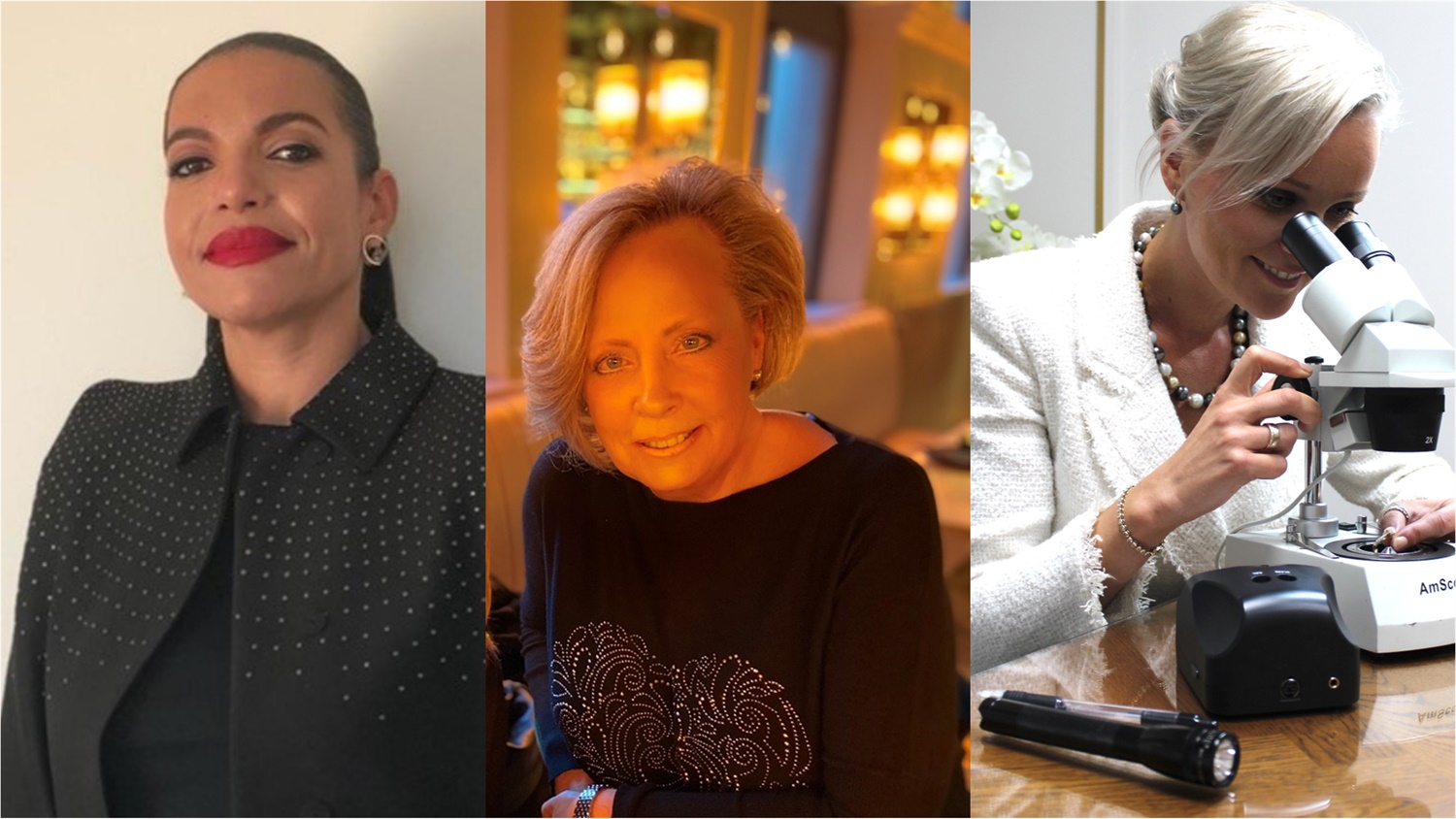
With 2023's campaign theme #EmbraceEquity, today is International Women's Day. Equity means creating an inclusive world. We mark this day – and continue for the next two days – by celebrating the achievements of successful women in our industry, who talk about their jewellery journeys, female empowerment and inequality issues.
MELANIE GRANT, Executive Director, Responsible Jewellery Council, author and curator
Describe your jewellery journey
As a child, I was fascinated with metal – the gleam and strength of it and the ways it could be bent into magnificent sculptural shapes on a large scale in museums but also on a small scale on the body. I went to the Tate Modern with my mum and saw Umberto Boccioni's Unique Forms of Continuity in Space 1913, cast in bronze, and it was like being hit by a truck. I was mesmerised, and I knew in some part of my mind that I'd find a way to be close to metal as I got older.
Then while I was at The Economist, I had a similar moment at the Cartier: Style and History exhibition at the Grand Palais, but it was about diamonds this time. I went to cover the show and stood next to a vast display of stunning tiaras with a gaggle of local women who had tears in their eyes. I asked them what was wrong, and they told me they were cleaners and had never thought they would be allowed to see anything this beautiful, and they were overwhelmed. So we just stood there together crying because, really, I felt the same.
From that point on, I started writing about jewellery in earnest, and it changed my life. It consumed me, and I became obsessed with it, and still today, I can't believe how much it has taught me. I know it's art because when I look at the best jewellery, I feel exactly how I did at Tate Modern. My new role at the RJC is exciting for me because I'm examining an entirely new side of the industry, and I'm learning all over again. It's thrilling meeting new people and discussing the challenging issues around sustainability, to be involved with the future of jewellery. I feel honoured to have been asked.
Would you say that being a woman has impacted your career?
I like to think that everything I've been through (good and bad) has led me to this moment. Being a woman and being a black woman has been an extremely enriching experience for me, even before the MeToo and Black Lives Matter movements shed light on what it was to be us, and our voices became stronger. I remember when women were expected to wear skirts to work, and no one seemed to want a female boss when expectations that we might change the world or challenge the status quo were much lower than they are today. When I was a teenager, most of my friends wanted to get married and start a family; my goals were always around career, and I feel lucky to have achieved so many of the things I wanted. I'd say being a woman has been one of the highlights of my life.
Do you think women have had to work harder to be more 'visible'?
One thing I've realised is that the 'work' is everything. Put all you have into it, finesse it, learn through it, believe in it and do it because you have to and love it. If you find your calling and connect with it tirelessly every day, then suddenly, when you least expect it, visibility occurs. It soars when your moment comes, but that can take 20 years, and women often have a lot of distractions because we're expected to look after everyone else. So yes, we often work harder because we're working multiple jobs at home and at work all our waking hours. When my book Coveted: Art and Innovation in High Jewelry came out, I was unprepared for the reaction to it because visibility wasn't something I thought about. It was a by-product of a decade of learning. Women are still so often celebrated for their physical rather than mental beauty, but we deserve to be recognised for our intellectual contribution, whatever that might be.
Does the jewellery sector actually offer workplaces where women can thrive?
There are so many phenomenal women in jewellery on the design side, such as Michelle Ong and Jacquline Rabun, but also running mining companies, such as Eira Thomas and Naseem Lahri. Ninety per cent of the jewellery created globally is worn by women, and more and more of us are buying at the highest level with our own hard-earned money. It's a female-centric industry, and I think workspaces reflect that. I recently visited some workshops at The Goldsmiths' Centre in London, and most of the people I met were women. It feels like a good time for women to be in jewellery.
Have you ever been in a situation where you have had to call out inequality?
I curated two Sotheby's exhibitions called Brilliant and Black, where the work of designers of African origin was showcased in New York and London to highlight talent previously overlooked at the highest level. This type of inequality is hard to address because it's systemic and fused historically to business, but it felt like a good start to an ongoing conversation around access to opportunity. Inequality, in my view, is about social and economic power, and if you have it, do something with it.
What does 'female empowerment' mean to you? Does it allow the promotion of self-worth and/or the ability to influence change?
Female empowerment, to me, is about freedom. Having the freedom to wear what I want, go where I want, spend what I want, be with who I want and be who I want. I'm not asking for permission or seeking approval because these are my choices. I love and believe in myself, and I share that positivity with others. This, in turn, creates change. I think confidence is the key, and behind that is self-worth. My mum told me I could be anything and do anything as a child, and I believed her, so tell your little girls they are brilliant without reservation, and great things will inevitably happen.
CARLA GOODFELLOW, Guardian, Birmingham Assay Office
Describe your jewellery journey up to this point in your career.
My 'jewellery career' began by chance and then became my passion… and remains so. At 18, I worked for Champney's as an aesthetician and then moved to Bermuda to do the same. Back in the UK, I was offered a Christmas job in the postroom of Chris Dear's Gallery Jewellers. It eventually became G&A, part of Abbeycrest jewellery manufacturers.
I was supposed to be there for a few months but stayed for 18 years. I was ambitious and given the opportunity to work in nearly every aspect of the business: running the one-off specials area, customer liaison, managing the stone room, new product development and eventually, all the manufacturing operations. In each area, I reviewed processes, staffing, and training and changed and improved things. I quickly learnt all aspects of the trade and, most importantly, people management. Eventually, I became the overall site manager.
Abbeycrest decided to transfer production from the UK to Thailand, so for the last five years of my time there, I worked between the UK and Thailand as part of the transfer project team designing the layout of the new factory, recruiting and training the staff. It was exciting – a time of very high, mixed emotions. I was the last one out of the door when Abbeycrest closed.
I was approached by The Birmingham Assay Office to apply for the role of operations manager for SafeGuard Jewellery and Watch Valuations and AnchorCert Gemmological Laboratory. After seven years, I was promoted to director of operations and managed the hallmarking operation and the Analytical Laboratory. As always throughout my career, these were different and new processes to learn and new teams to manage. Eventually, I was offered the Operations and Business Development role and became more involved with customers and helping promote the existing business and find new avenues.
In 2022 I retired to join my jeweller husband, who'd retired 12 months earlier. It was the hardest decision I've had to make, but I feel fortunate – as a Guardian at The Birmingham Assay Office and being on the NAJ IRV Committee, I still manage to get my fix.
Would you say that being a woman has had an impact on your career?
From my experience, I never felt it had a bearing on my career progression and development. My opportunities at G&A meant I helped create and push, supported by some fantastic bosses. I delivered on my roles and drove changes and developments, so I was always promoted onwards. It was the same at the Birmingham Assay Office; I was given great opportunities, but I also delivered on them.
The senior management teams at both businesses were fairly represented by men and women, and the female voices and opinions were heard as loudly as others. However, the operational workshops I managed 35 years ago were all male-orientated; there were no female mounters, setters, engravers etc. Over time I've started to see this change… but slowly. That's why I love to see opportunities like The Birmingham Assay Office Career Days and the Striking Futures days coordinated by the NAJ with all the Assay Offices. The number of young female designers and jewellers is growing – great to see! Also, training organisations like BCU and BJA are supporting equality and development within the trade.
Does the jewellery sector actually offer workplaces where women can thrive?
I believe it does. Within the Birmingham Assay Office, for example, all roles are available to men and women. If you have the determination, spark and drive, you can progress and develop within the business. One of the main focuses for us is staff development and progression. Looking at our teams, I see a true mix in all areas – hallmarkers, valuers, gemmologists, analytical chemists, and business development. I also see other businesses in the trade pushing this way, such as Weston Beamor, Hockley Mint, Cooksons etc. You can see it is a true commitment now to ensure equal opportunities.
What does 'female empowerment' mean to you? Does it allow the promotion of self-worth and/or the ability to influence change?
I read 'female empowerment', as a total commitment to fairness and equality. People should be judged on their own endeavours and be allowed the same chances to shine and progress in their careers. I'd like to believe that everyone has the same chance to achieve whatever they set their sights on in the same way that I felt I was, regardless of gender.
I see empowerment as the opportunity and support to get to where you want to be and rise as high as your skills can take you.
I think self-worth is vital, and giving people the confidence to try different experiences to know where they want to be is crucial. How do you know what you want unless you are given the opportunity? Creating equal opportunities within all business is key. I've had some of the most amazing bosses – male and female – who've always encouraged and pushed me to be the best version of myself. These chances and opportunities have helped me to continue to give other people the opportunities to become who they want to be. Empowerment is a gift, and I believe you should spend your time paying it forward.
ANNA ROGERS, MIRV, GIA
Describe your jewellery journey up to this point in your career.
It started in 2009 when I joined a fairly small regional auction house as a junior cataloguer. I had to multitask and take on different responsibilities. Hundreds of items went through my hands for examination and cataloguing, from German Meissen porcelain to jewellery items. The latter was fascinating.
Shortly after, I joined the retail jewellery business. My husband (a jeweller) told me, "You have a natural intuition for diamonds and gemstones. You should study gemmology". Which I did and continue to do so to this day. I enrolled in a GIA distance learning course, which allowed me to combine study, work and looking after my young children. The course was very complex and challenging – I graded hundreds of gemstones to submit my results for assessment.
In 2018 I graduated and, in 2019, became an NAJ Registered Jewellery Valuer (IRV) – a logical continuation of my gemmology studies. In 2020, I left retail jewellery and established Almaz Jewellery Valuations – an independent jewellery valuation consultancy. It was a significant career change – I could finally concentrate on my favourite field and balance my time between work and family. Shortly after, the renowned jewellery valuer Rosamond Clayton suggested my candidature for the London Diamond Bourse membership, where I have my Hatton Garden office today.
I work with private clients providing insurance, probate, resale, and other types of valuations. My practice also includes receiving instructions from solicitors on Division of Assets valuations and police station visits for jewellery examination. As a member of the Academy of Experts in London, I undertake legal work too. Recently I completed the expert witness report for matrimonial proceedings in court.
Does the jewellery sector actually offer workplaces where women can thrive?
The jewellery sector is hugely varied. Some fields are known for being predominately male, while others have a high number of women. Working in retail, I've noticed that clients would buy more willingly from female sales assistants. This could be unconscious bias or show that women are more tactical in their sales techniques. Women typically have a good sense of intuition, which is a powerful tool in sales.
As an independent valuer, I'm occasionally chosen because the client likes the fact that I'm a woman. In situations like divorce, women are often more willing to book jewellery valuations with female specialists. The jewellery valuation in the division of assets situation can be a sensitive subject for both parties. And although the valuer's principle is to stay impartial, some female clients feel more comfortable discussing their valuation enquiry with a female valuer.
What does 'female empowerment' mean to you? Does it allow the promotion of self-worth and/or the ability to influence change?
I like to associate 'female empowerment' with one of the dramatic moments in the UK's late modern history – the suffragette movement. In 2028, we'll mark the 100th anniversary of the Equal Franchise Act of 1928, which granted equal voting rights to women and men. As a result, both men and women could vote at the age of 21. The movement demonstrated the incredible courage of women in the advancement of their rights. Besides the unprecedented political impact, the suffragettes' movement has left us with beautiful jewellery pieces.
This International Women's Day, I want to give words of encouragement to women working in the jewellery industry. Looking after yourself, your family and friends, being healthy, living an exciting life and building a successful career – are seriously challenging for any woman. The years spent in the jewellery trade taught me that there are no impossible situations. No matter how hard the situation appears to be, take your time to analyse and meet the challenge face-to-face, with confidence… and a smile!
Read Part 2 of our International Women's Day Series
Read Park 3 of our International Women's Day Series
Source: NAJ Online